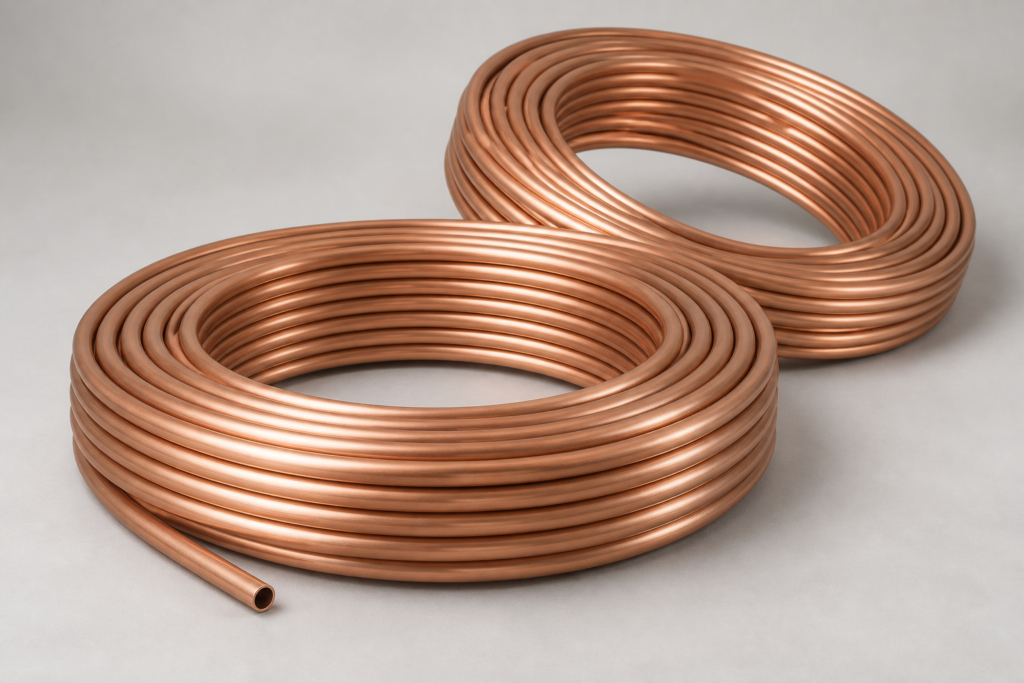
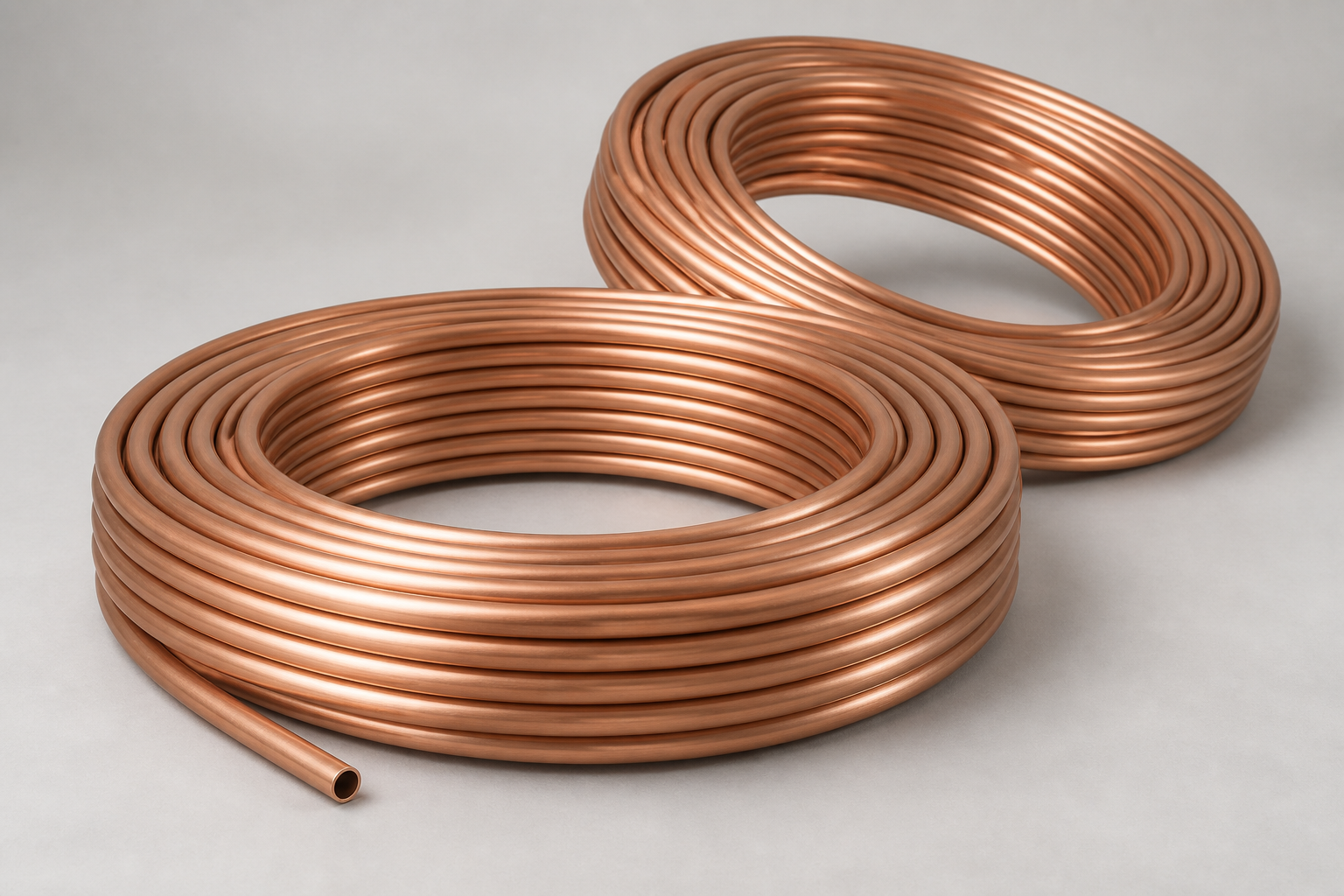
One coil. More freedom to fabricate.
Fewer intermediate joints
A continuous coil can cover a longer route than individual straight pieces, reducing the number of intermediate connections where the installation design allows.
Formable soft temper
Annealed tubing can be bent, flared or expanded with suitable tools. Select bend radius and wall thickness together to control ovality and avoid kinking.
Compact delivery
Pancake coils simplify handling for field work. Level-wound coils support controlled pay-off into straightening, cutting and automated forming equipment.
Installation coils or production coils.
Pancake / service coils
Compact circular coils, normally annealed, for refrigeration service, connection lines and on-site fabrication. Common enquiry lengths include 15 m, 20 m, 25 m, 30 m, 50 ft and 100 ft, depending on size and specification.
Specify the tube OD, wall, total length, coil diameter, wrapping and end closure. A 50 ft coil equals 15.24 m; it is not the same length as a 15 m coil.
Level-wound coils
Long, orderly wound tubing for equipment manufacturers. Coil mass, bore diameter, traverse width, pay-off direction and winding pattern are matched to the production line.
Supply condition can be tailored for forming or automated feeding. Length continuity, permitted joints and defect marking must be agreed in the order.
High-purity copper.
Controlled phosphorus.
C12200 is phosphorus-deoxidized copper with high residual phosphorus, commonly called DHP copper. The closely corresponding European designation is Cu-DHP / CW024A; equivalence is confirmed against the selected product specification.
Phosphorus removes oxygen during production and improves suitability for brazing and soldering. The remaining phosphorus reduces electrical conductivity compared with ETP and oxygen-free copper.
| Element / constituent | Composition, wt.% | Purpose or control |
|---|---|---|
| Copper including silver, Cu + Ag | 99.90 minimum | Highly conductive copper matrix. Silver is counted with copper. |
| Phosphorus, P | 0.015–0.040 | Residual deoxidizer; supports dependable thermal joining. |
| Other residual elements | Per ordered specification | Any individual limits for Fe, Pb, Zn or other residuals are defined by the purchase specification and verified by batch analysis. |
C12200 is deoxidized copper, not an oxygen-free electronic copper grade. Material documentation can be requested with heat or lot identification and the applicable composition requirements.
Softness is a production choice.
Coiling, drawing and annealing influence tensile strength, yield strength, elongation and grain size. Soft service coils prioritize formability; harder level-wound products may suit particular production lines. Use the temper and mechanical requirements of the ordered standard rather than treating all C12200 coils as identical.
| Condition / selection basis | Tensile strength Rm | 0.2% proof strength Rp0.2 | Elongation | Typical role |
|---|---|---|---|---|
| R220 annealed, EN 1057 benchmark | ≥220 MPa | Agree if required | ≥40% | Soft tube for bending and installation, within the standard’s size scope. |
| Y040 light-annealed LWC engineering benchmark | ≥220 MPa | 40–90 MPa | ≥48% | Controlled forming stock; a 15–35 µm grain-size target can be specified for this supply basis. |
| R250 half-hard LWC benchmark | ≥250 MPa | Agree if required | ≥30% | Balance of feed stability and forming response. |
| R290 hard LWC benchmark | ≥290 MPa | Agree if required | ≥3% | Higher strength where substantial forming is not required. |
Define the acceptance values
The LWC figures are engineering selection benchmarks for Cu-DHP equipment tubing, not a blanket guarantee for pancake coils. ASTM coil tempers use their own designations and acceptance requirements. Hardness, grain size, tensile-test method and inspection frequency can be specified when relevant to your forming process.
Bending & joining behavior
Repeated bending work-hardens copper and reduces remaining ductility. Brazing can soften previously cold-worked sections. Use a suitable tube bender, deburr cut ends, and qualify the finished joint and bend geometry for the application.
A strong conductor
of thermal energy.
High heat conductivity makes C12200 useful in evaporators, condensers and heat-transfer circuits. Good solderability and brazability help integrate formed tubing into assemblies.
These are typical alloy properties near 20°C, except where another interval is stated. They are material-selection values, not individual batch acceptance limits.
| Property | Typical value |
|---|---|
| Density | 8.94 g/cm³ / 8,940 kg/m³ |
| Thermal conductivity | Approximately 330 W/(m·K) |
| Electrical conductivity | Approximately 85% IACS |
| Electrical resistivity | Approximately 2.03 × 10⁻⁸ Ω·m |
| Specific heat capacity | Approximately 385 J/(kg·K) |
| Elastic modulus | Approximately 117 GPa |
| Shear modulus | Approximately 44 GPa |
| Thermal expansion, 20–100°C | Approximately 16.9 × 10⁻⁶ /K |
| Melting temperature | Approximately 1,083°C |
Size the tube and the coil.
The following rounded metric dimensions represent common refrigeration-service enquiry combinations. Confirm exact inch or metric dimensions, wall tolerance, temper and availability in the quotation. These combinations do not establish a working-pressure rating.
| Actual OD, inch | OD, mm | Wall, mm | Calculated ID, mm | Theoretical kg/m |
|---|---|---|---|---|
| 1/4 in | 6.35 | 0.76 | 4.83 | 0.119 |
| 5/16 in | 7.94 | 0.81 | 6.32 | 0.162 |
| 3/8 in | 9.52 | 0.81 | 7.90 | 0.198 |
| 1/2 in | 12.70 | 0.81 | 11.08 | 0.270 |
| 5/8 in | 15.88 | 0.89 | 14.10 | 0.375 |
| 3/4 in | 19.05 | 0.89 | 17.27 | 0.454 |
| 7/8 in | 22.22 | 1.14 | 19.94 | 0.675 |
Metric & custom requirements
Common metric enquiries include 6 × 0.8, 8 × 0.8, 10 × 1.0 and 12 × 1.0 mm. Other OD / wall combinations and coil lengths can be reviewed against application, tooling and production availability.
Internal diameter = OD − 2 × wall. Theoretical mass in kg/m ≈ 0.02809 × (OD − wall) × wall, with dimensions in millimetres. Multiply by the ordered length for nominal coil mass; packaging is additional.
Coil parameters to confirm
- Tube OD, wall thickness, dimensional tolerances and roundness after uncoiling.
- Length or net mass per coil, winding arrangement and continuity requirements.
- Coil inside diameter, outside diameter, height and maximum package mass.
- Annealed condition, surface finish, bore cleanliness and sealed-end requirements.
| Specification route | Typical purpose | Order details |
|---|---|---|
| ASTM B280 | Air-conditioning and refrigeration tubing | Size, temper, cleanliness, dehydration, end closure and prescribed tests. |
| EN 12735-1 | Refrigeration and air-conditioning pipe systems | Pipework dimensions, supply condition and internal surface requirements. |
| EN 12735-2 | Refrigeration and air-conditioning equipment tubing | Forming stock, mechanical condition, geometry and application-specific inspection. |
| ASTM B75 | General seamless copper tubing | Dimensions, temper and mechanical requirements for fabrication. |
| ASTM B88 / EN 1057 | Water or heating tube where applicable | Relevant size series, condition and product approvals for the intended installation. |
Specify the applicable standard and edition. Alloy chemistry alone does not demonstrate refrigeration cleanliness, drinking-water approval or compliance with every listed standard.
From field connections to thermal equipment.
HVAC & refrigeration
Air-conditioning connections, refrigeration service lines and fabricated equipment circuits. Order cleaned, dried and sealed tubing when required by the refrigeration specification.
Heat exchangers
Formed evaporator and condenser tubing, heating coils and cooling circuits. Specify grain structure, expansion behavior and final geometry where tube forming controls assembly quality.
OEM fluid assemblies
Custom bent lines and compact thermal or fluid-transfer components. Confirm medium compatibility, pressure, vibration and the joint system for the finished assembly.
Pressure capability depends on tube size, minimum wall, temperature, final temper and joining method. Copper is not a universal choice for every refrigerant or fluid; ammonia service and high-pressure CO₂ systems require material and system-specific engineering.
Choose for the complete system.
| Alternative material | Where C12200 is useful | Where the alternative may be preferable |
|---|---|---|
| C11000 ETP copper | Deoxidized chemistry supports thermal joining and avoids the oxygen-related hydrogen embrittlement concern associated with ETP copper in reducing atmospheres. | Higher electrical conductivity makes C11000 attractive for electrical conductors; C12200 sacrifices some conductivity to residual phosphorus. |
| Oxygen-free copper | A practical choice for conventional fluid and heat-transfer tubing, with good forming and joining performance. | Higher conductivity and controlled purity are valuable for electronic, vacuum or specialized electrical applications. |
| Aluminum tubing | Higher thermal conductivity than many common aluminum tube alloys and familiar copper brazing and flaring practices. | Substantially lower weight and potentially lower material cost. Joint design, corrosion compatibility and fabrication processes differ. |
| 304 / 316 stainless steel | Much better heat conduction, easier soft-state forming and well-established copper joining methods. | Greater strength and better resistance to some aggressive media. Stainless steel can require different tooling and joining procedures. |
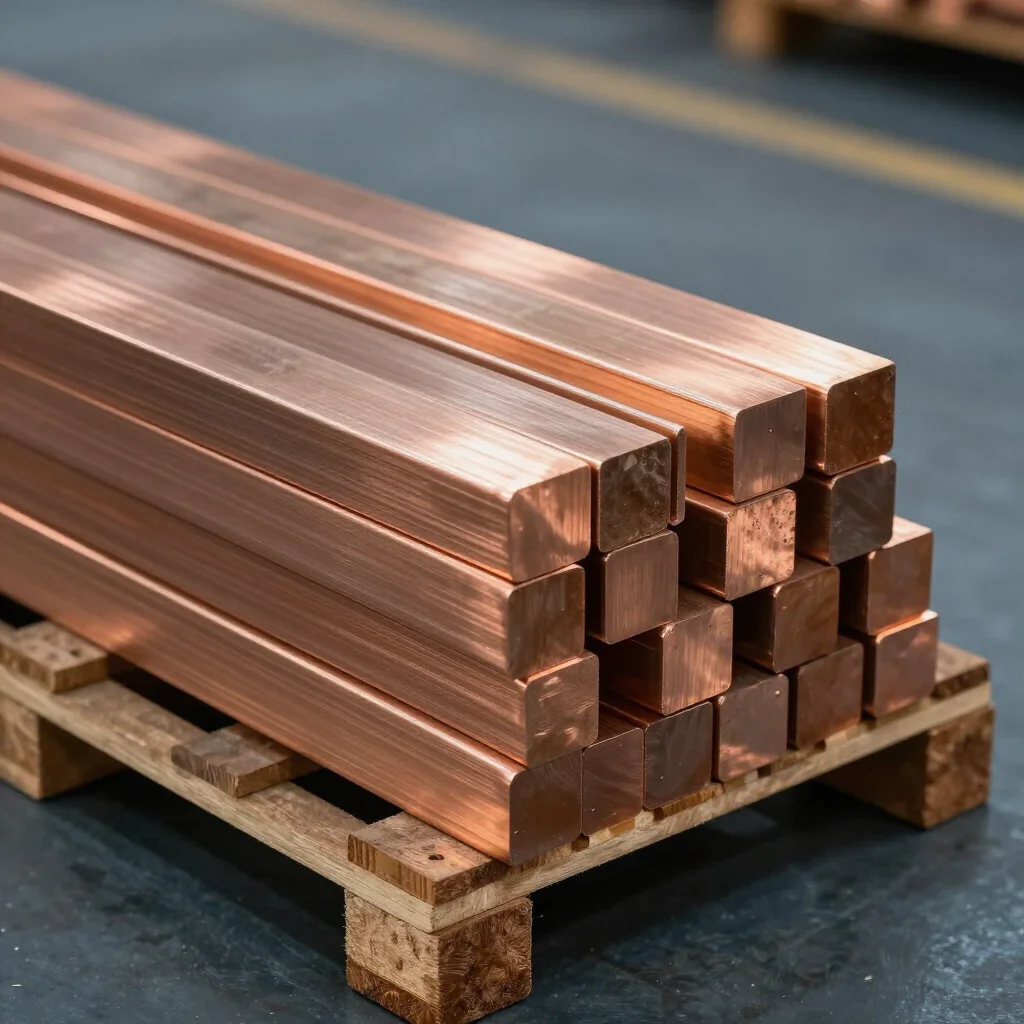
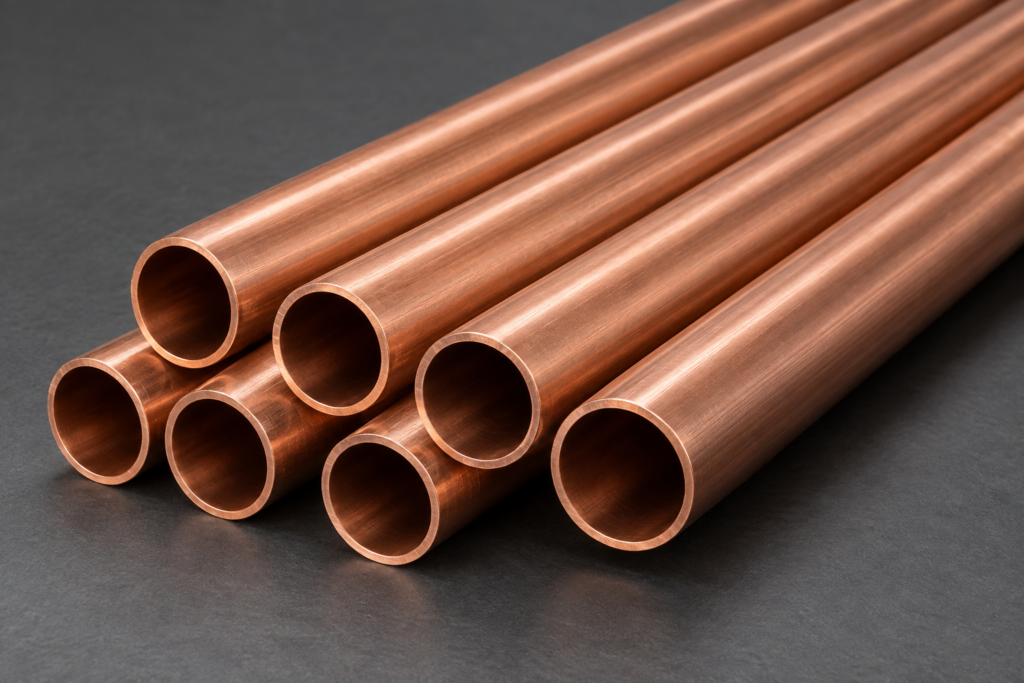
For the same copper grade, coils offer longer uninterrupted runs and compact shipment; straight tube offers easier alignment and rigid handling. Select the delivery format according to installation layout and fabrication equipment. Explore C12200 straight copper tube for straight-length supply, or C11000 copper busbar when the requirement is an electrical conductor instead of a fluid line.
We can prepare more than a coil.
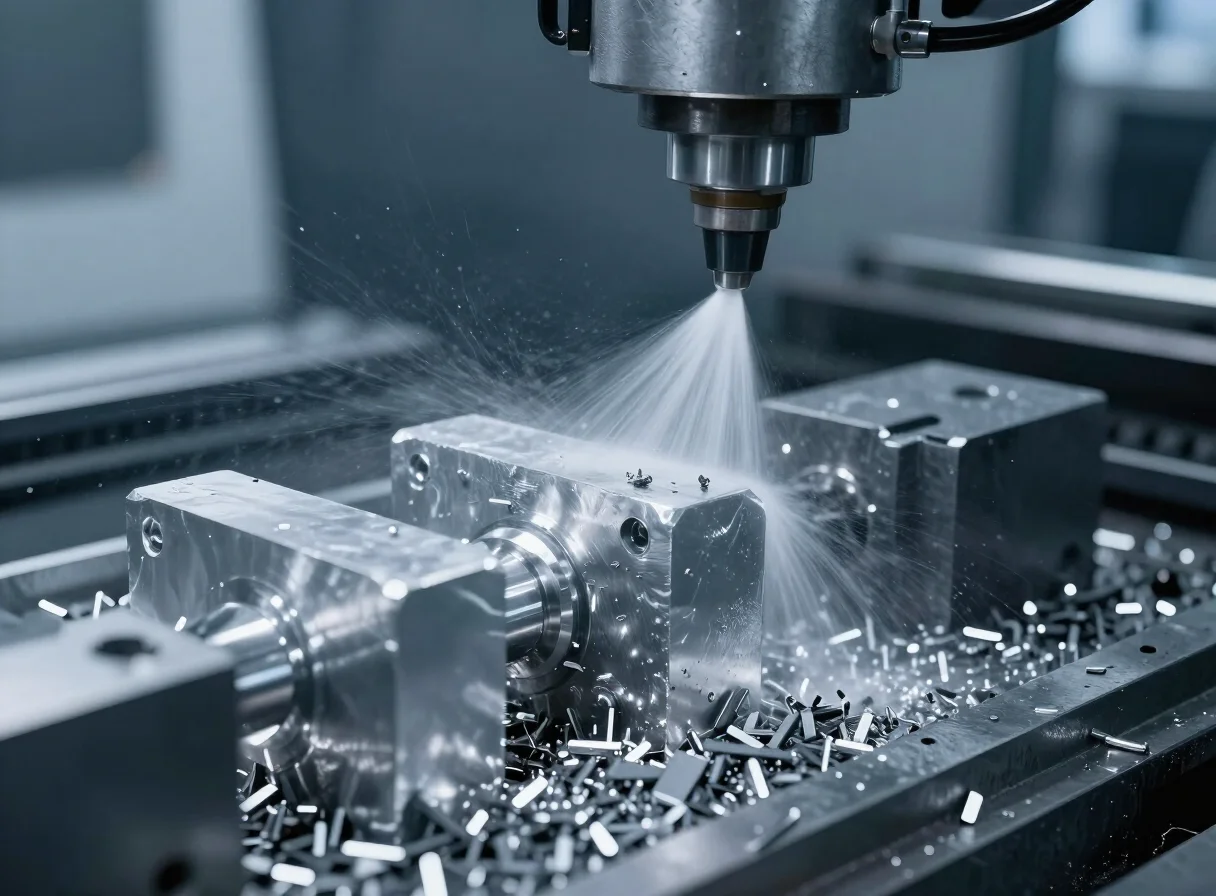
From your drawing to supply.
- Coil-length selection, rewinding or controlled pay-off preparation.
- Straightening and cutting to specified component lengths.
- Deburring, chamfering, flaring, expanding and reducing tube ends.
- Bending and formed tube components after tooling and feasibility review.
- Part identification, grouping and protective finishing or cleaning as agreed.
Share the drawing, quantity, critical dimensions and intended joining process. Sample approval, tooling and inspection points can be included before production.
Specify. Inspect. Document.
Confirm the alloy and temper.
Request heat or lot identification and material test documentation. Chemistry and mechanical properties are reviewed against the ordered supply basis.
Control what affects your process.
OD, wall, roundness, surface condition, coil geometry and length can be checked to agreed limits. Expansion, tensile, hardness or grain-size testing can be specified where required.
Match inspection to service.
Eddy-current, leak and cleanliness tests can be arranged under the applicable specification. For refrigeration service, agree bore cleaning, drying and end closure before dispatch.
Third-party inspection, witness points and the required inspection certificate can be included by agreement. Certification scope and acceptance criteria are confirmed with the order.
Keep each coil supported and protected.
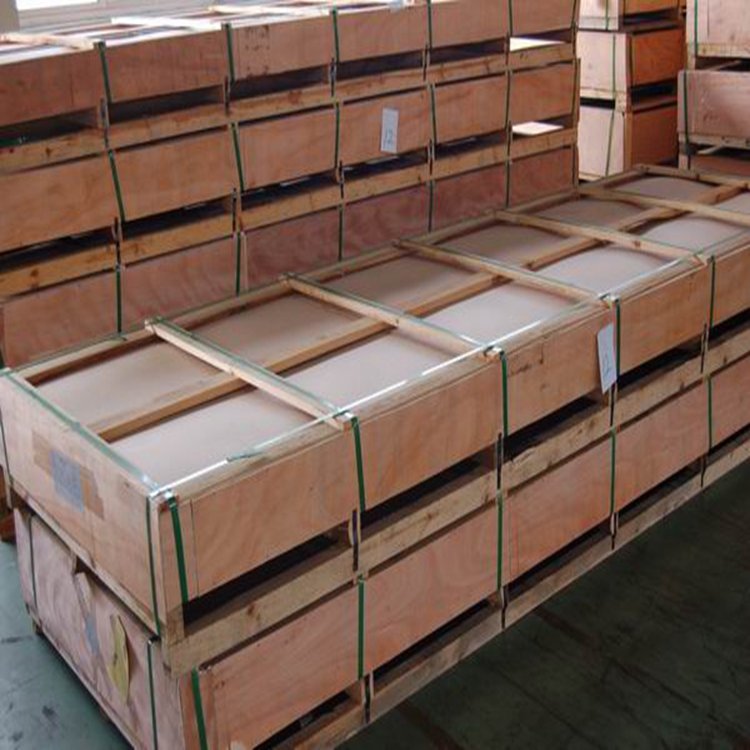
Coil-specific protection
Service coils can be wrapped and individually boxed. Larger coils can use separators, supported pallets or wooden cases. Protective end caps and suitable restraint help preserve bore cleanliness and prevent coil distortion.
Specify labels with alloy, OD × wall, temper, coil length or mass, batch and package number. Moisture protection, stacking limits and treated solid-wood packaging can be arranged for the destination.
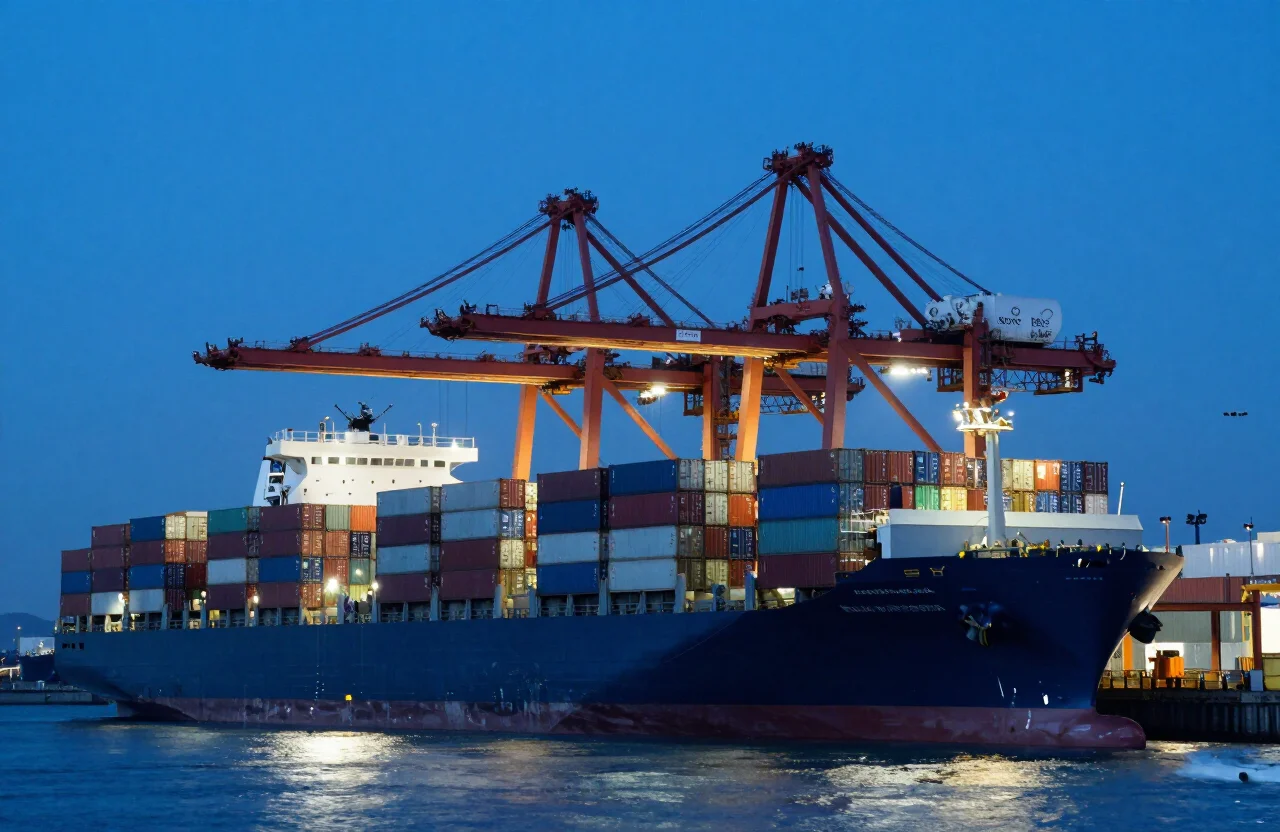
Delivery planned around your order
Sea freight can suit bulk orders; air freight can support urgent production needs. Samples or suitable small coils can travel by courier. The transport method is selected using package size, quantity and delivery schedule.
We can coordinate packing lists and shipping documents. Incoterm, destination charges, insurance and lead time are confirmed in the quotation.
Your diameter. Your length. Your production needs.
Send the tube OD × wall, coil format, temper, length or mass per coil, total quantity, application standard, cleaning requirements, processing drawing and delivery destination. We will review the details and prepare a supply proposal.
Reviews
There are no reviews yet.